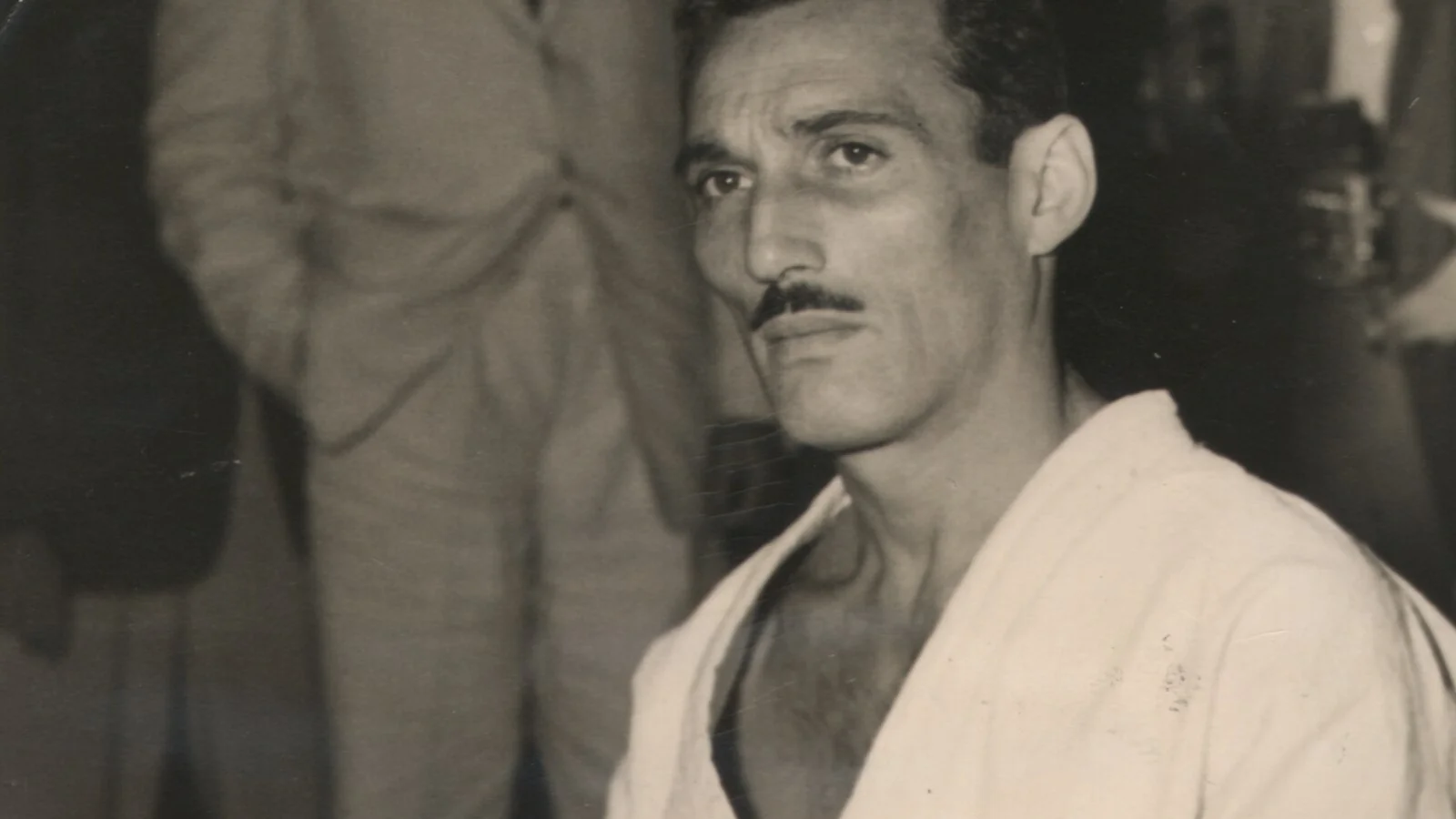
October 22, 1951. Maracanã Stadium, Rio de Janeiro. A 38-year-old Brazilian named Hélio Gracie walks to the centre of the mat in front of 20,000 people, including the president of Brazil. The man across from him is Masahiko Kimura, a Japanese judoka considered the greatest grappler alive — 80 lb heavier, Kodokan-trained, on a Brazilian tour to defend Japanese honour after Hélio's older brother Carlos had been publicly issuing challenges to any Japanese fighter who would take one. Thirteen minutes in, Kimura catches Hélio's left arm in a reverse double wristlock, applies torque, and the shoulder breaks. Hélio does not tap. His brother Carlos throws in the towel from the corner. Hélio walks off the mat under his own power, beaten, his arm hanging limp.
The Japanese gave Kimura's signature lock its formal name decades earlier — gyaku-ude-garami. Brazilian jiu-jitsu calls it "the Kimura" to this day, named for the man who used it to break the founder's arm. That is the only honest place to start a story about Helio Gracie technique. The man lost. He did not give up. The art was built on what he refused to do that day.
The boy who was too sick to train
Hélio was the youngest of five Gracie brothers, born October 1, 1913, in Belém, the same Amazonian port city where a Japanese judoka named Mitsuyo Maeda had stepped off a boat the year after he was born. (For the prequel to this story, see how Mitsuyo Maeda brought judo to Brazil.) Hélio was thin, pale, prone to fainting spells. Doctors told the family he was not to engage in physical exertion. His older brothers — Carlos, Oswaldo, Gastão Jr., Jorge — trained on the family mat. Hélio watched.
He watched for years. He watched Carlos teach. He watched the students drill. He memorised sequences he was forbidden to attempt. The doctors' prohibition was not a footnote; it was a frame around his entire adolescence. While Carlos was learning the throwing-and-groundwork judo of Maeda first-hand around 1917 in Belém, Hélio was an asthmatic child who got winded on the stairs.
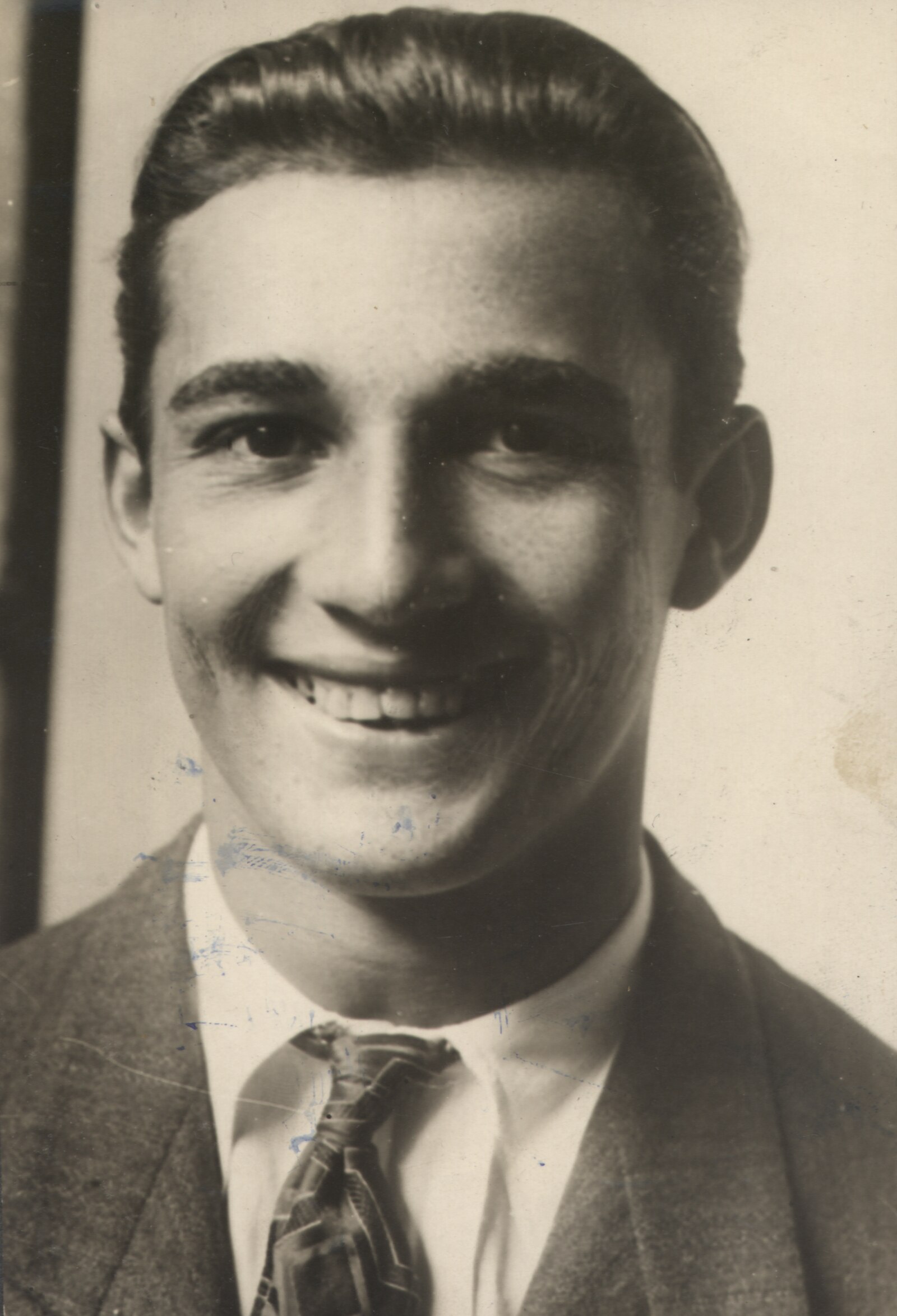
The pivot came when he was sixteen. A bank director named Mario Brandt, one of Carlos's private students, arrived at the academy for a scheduled class. Carlos was late. Hélio offered to begin the class himself. When Carlos finally walked in, Brandt asked to continue with Hélio. The student's preference was clear, and the family obliged. Hélio became an instructor that afternoon.
The Helio Gracie biography goes through a thousand inflections after that moment, but the load-bearing fact never changes: the man teaching had spent most of his life forbidden from doing what he was now teaching. The technique he taught was not the technique he had drilled to muscle memory across a decade of randori. It was the technique he had reasoned out, in his head, from the side of the mat, as something a body like his could plausibly execute.
Leverage as the only honest option
Every martial art tells a story about why it works. Boxing's story is hand speed and angles. Judo's story is kuzushi — breaking the opponent's balance before the throw. Wrestling's story is positional control. Helio Gracie technique tells a different story, narrower and harder to fake: a 140 lb man cannot win against a 200 lb man using strength, ever, so he must build a system that operates entirely on leverage, timing, and structural geometry.
That premise sounds like marketing copy today because the BJJ industry has worn it smooth. In 1930s Rio, it was a structural engineering problem. Hélio's question, in concrete form: which version of an armbar works when the man you are applying it to outweighs you by 60 lb and is actively resisting? The judo answer — the juji-gatame with the hip break and the slight arch — depended on a hip pop that a frail man could not deliver against a heavy resisting limb. The Helio answer was to refit the lock so the lever did the work. Adjust the wrist angle. Position the hips against the elbow joint, not next to it. Eliminate every degree of freedom the opponent had to bend their arm. Make the technique impossible to escape before you applied the force, so the force needed was small.
Multiply that re-derivation by every position in the art. The mount became less about hitting from on top, more about controlling the hips so the opponent could not bridge. Side control became a list of frame-breaks and weight distributions, not a pin. The guard — the position from your back, legs around the standing opponent — was upgraded from a judo afterthought into the centre of the system: a way for a man on the bottom to be the threat, not the threatened.
This is what made the art technically distinct from the Kodokan judo Maeda had brought over. Maeda's groundwork was real and complete — ne-waza was a third of pre-Olympic judo. But Maeda's groundwork was a continuation of his throw. Hélio's groundwork was the whole architecture. Subtract throws and the system still functioned. The man at the bottom of a tangle of limbs was not a man who had failed; he was a man who had set the trap.
The Brazilian Portuguese phrase for this kind of street-smart, leverage-first, brute-strength-rejecting technique is técnica de suburbano — suburban technique, or working-man's technique. The boys who couldn't afford the gentleman's training the early Gracie Academy charged a small fortune for, learned it on side streets and in favela mats and brought it back to compete. By the 1950s, Helio's stripped-down armbar — refit for a 140 lb body to apply to a 200 lb arm — was the version every Brazilian grappler was learning, whether they trained with the Gracies or against them.
Vale tudo, and the public proof
If the technical premise had stayed in the academy it would have stayed an interesting hypothesis. The Gracie family did not let it.
Starting in the 1930s and accelerating through the 1950s, Hélio and his brothers ran what became known as the Gracie Challenge — a public, open invitation: any fighter from any style, in our gym or in a stadium, vale tudo (anything goes), see who wins. Some accepted in pursuit of money. Some accepted because they thought BJJ was a Brazilian con on Japanese judo. Some, eventually, accepted because the Gracies had insulted them in print.
Hélio fought. By the count of the family ledger, somewhere between fifteen and twenty officially sanctioned matches over twenty-five years — fewer than the family mythology implies, more than enough to make the case. Most ended in submission, with Hélio applying the same handful of holds he had refined in the academy: the mounted cross-collar choke, the rear-naked choke from the back, the armbar from the guard. None of his opponents were professionally trained to defend against a system that lived on the ground. Most of them had never been on their back in a fight.
What the public saw, repeatedly, was a small man defeating large men without throwing a punch. That is the load-bearing image of the entire Gracie marketing apparatus from Hélio's career through to Royce's at UFC 1 forty years later. It was not a marketing gimmick. It was the technical thesis of the art, demonstrated in a stadium, against a fighter from a different style, with the rules turned almost entirely off.
By the time Kimura came to Brazil in 1951, that thesis was load-bearing on the family business. The challenge had to be accepted.
The Kimura fight, in the only way it should be told
Three weeks before Kimura, Hélio fought another Japanese judoka named Yukio Kato. The first match ended in a draw on September 6, 1951. The Gracies, smelling weakness, demanded a rematch. On September 29, Hélio caught Kato in a baseball-bat choke from the bottom and put him to sleep. Brazil noticed. Japan noticed harder.
The Japanese judo community sent Kimura. Hélio was 38, the Brazilian was somewhere around 5'9" and 140 lb. Kimura was 34, 5'7" and 185 lb, Sandanshi champion, holder of the All-Japan Judo championship four times, considered by his own peers — and they were not generous men — the greatest judoka of the twentieth century. The pre-fight terms were public: if any of the Gracies managed to last three minutes against Kimura, the Japanese side would consider it a win for Brazil.
Hélio lasted thirteen minutes. He took Kimura down. He recovered guard repeatedly when Kimura passed. He survived the throws. He worked from underneath against a man whose career was throws. Then Kimura caught the arm.
The reverse double wristlock — gyaku-ude-garami in judo, "the Kimura" in BJJ forever after — applies torque to the shoulder joint by wrapping behind the opponent's back. The arm rotates inward against its natural range. There is no escape once the configuration is set. Either the opponent taps, or the shoulder breaks.
Hélio's shoulder broke. The audio of the snap is on the surviving fight footage. He did not tap. He could not tap. His left arm was useless, but he was still alive, still conscious, still on his back. Kimura was a famously calm man, but he was looking at a man who was not surrendering with a broken arm, and the next thing he was going to do — if Hélio did not tap, if Carlos did not throw in the towel — was break it again at the elbow.
Carlos threw in the towel. Hélio stood up, walked off the mat, and was hospitalised for the shoulder.
Two things about this fight matter for the technique-from-a-small-body story.
The first is what Hélio did not do. He did not get hit. The premise of the art was: a smaller man cannot afford to absorb damage. The result of the fight was: a smaller man absorbed almost none. The submission was applied; the submission worked; the joint broke; but the man walked off whole, conscious, and intact. That is not a loss in the way a boxing knockout is a loss. The premise survived the result.
The second is what the BJJ community did with the technique. They renamed it after the man who had used it on their founder. Every modern Brazilian jiu-jitsu academy teaches "the Kimura," and somewhere in the lineage of every black belt who ever locked one up, there is a 38-year-old Brazilian on his back in Maracanã, refusing to tap, getting one applied to him.
You can hold the loss and the survival in the same hand. The story is more honest when you do.
The Santana fight, and the doctrine it produced
Four years after Kimura, Hélio took his last serious match. May 24, 1955, against Waldemar Santana — a former Gracie student, 26 years old, 31 lb heavier, fast, strong, and angry about a falling out. The match had no time limit, no weight class, no judges. Vale tudo.
It lasted three hours and forty-five minutes. Three hours and forty-five minutes of two men on a mat in front of a small audience, mostly grappling, occasionally striking, neither side able to finish. Late in the fourth hour, Santana caught Hélio with a soccer kick to the head. The referee stopped the fight.
It remains, by some counts, the longest sanctioned martial arts match in recorded history.
What the Santana fight did to Hélio's doctrine was this: it confirmed, against a younger, stronger, equally-skilled opponent, that his approach was correct and incomplete. He had not been finished by submission in either of his career-defining losses. He had been finished by the things the system was not built to handle — a shoulder lock from a 185 lb man, a strike from a 175 lb man — at ages 38 and 42 respectively. After Santana, he never fought competitively again. He went home and taught.
For the next half-century he insisted, publicly and repeatedly, that BJJ was a self-defense system that happened to have a competitive expression, not the reverse. Royce later quoted him on it directly:
"My father used to be like: 'Oh, don't hit your opponents. I don't want to hurt them. Win using technique.'"
The quote sounds like greeting-card philosophy until you place it next to the Kimura and Santana fights. The man saying don't hurt them, win using technique had himself been broken twice by men who hit harder. The doctrine was forged in the losses. Win using technique — because if you can't, you are the one who gets hurt.
The sons, the lineage, the belt
Hélio fathered nine children. The fighting Gracies among them — Rorion, Relson, Rickson, Royler, Royce, Robin — were trained from infancy. By the late 1970s, the second generation was old enough to start running gyms and challenging fighters in their father's name. The relevant ones for what came next:
- Rickson (thebjjstory.com), the second-generation grappler most insiders considered the heir to the technique. Undefeated competition record, vale tudo champion in Japan, the family's enforcer. The one Hélio reportedly believed could best execute the original art.
- Rorion (thebjjstory.com), the eldest son with Hélio's second wife, who moved to Los Angeles in 1978, taught BJJ out of his garage and then the Torrance academy, and built the franchise that would later produce UFC 1.
- Royce, twenty-six years old in November 1993, the one Rorion sent into the cage in Denver because he looked nothing like a fighter. The full story of what Royce did there is at Royce Gracie at UFC 1.
The transmission was clean. Royce in 1993 was teaching exactly what Hélio had been teaching in 1933. Same five or six submissions, same handful of positions, same insistence that the man underneath was the man in control. Sixty years and an ocean apart, the technique had not drifted, because the technique had been built for a body that nobody could out-strength, and bodies stayed small.
When Hélio finally died on January 29, 2009, in Petrópolis, at age 95, his black belts had to decide what to do with the rank he held — a 10th-degree red belt, formally the highest grade in Brazilian jiu-jitsu. The traditional Hélio-era ranking scheme had used only three colours: white for students, light blue for instructors, dark blue for masters. The red-belt grade had been invented by the federation decades later, after the family system was already federalised.
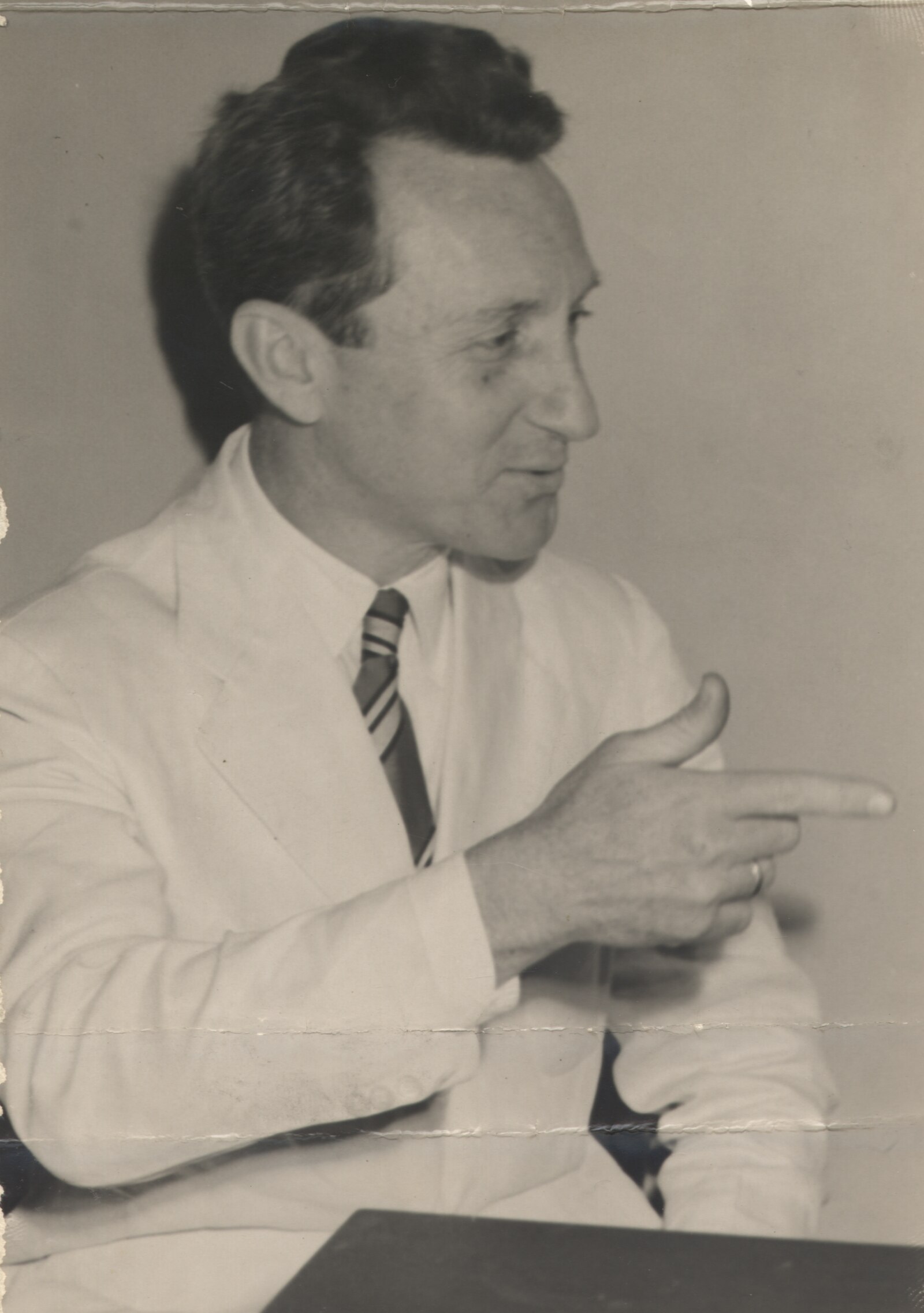
Hélio's son Royce — formally a coral belt under the federation — refused the coral. He still wears the navy blue belt his father gave him, with Hélio's signature on it. He has been explicit:
"I am representing the art of self-defense that my father created. So, I used a belt equal to his. I was always promoted by my father. After he passed, I put on an old blue belt like his, navy blue with his signature, in honor."
That is not nostalgia. It is doctrinal positioning. The coral belt is the rank of the modern sport federation; the navy belt is the rank of the original self-defense art. Royce wears the belt that names which jiu-jitsu he is teaching.
The split with Carlson, and what it cost
The hardest thing about writing an honest helio gracie biography is that the family was not unanimous. Hélio's nephew Carlson Gracie — Carlos's son, raised inside the academy — had been the most successful Gracie competitor of the 1950s and 1960s, with seventeen wins in eighteen vale tudo matches, including two against Waldemar Santana to avenge his uncle. By the 1960s, Carlson was openly building a different jiu-jitsu inside the family.
Carlson's vision was aggressive top-game pressure passing, ground-and-pound, cross-training in judo and wrestling. He opened group classes at affordable prices in Copacabana in 1965 — a direct repudiation of Hélio's expensive private-instruction model. He trained the poor for free. He produced a generation of competition specialists — Ricardo De La Riva, Murilo Bustamante, Mario Sperry, Vitor Belfort — who built the modern competition wing of the sport.
In a 2000 interview with O Tatame magazine, Carlson said it as plainly as anyone in the family ever has:
"My Jiu-Jitsu is completely different from theirs, my technique has nothing to do with 'Gracie Jiu-Jitsu.' I AM CARLSON GRACIE and that's the way it is in the ring. I want nothing to do with 'Gracie Jiu-Jitsu'. I am 'Carlson Gracie Jiu-Jitsu.'"
Hélio and Carlson never reconciled before Carlson's death in 2006. The split is what made modern BJJ a two-branch tree rather than a single trunk. One branch — Hélio's — insisted the art was self-defense first, sport second, and that the second was a dilution of the first. The other branch — Carlson's — insisted competition was the laboratory in which the technique actually got pressure-tested, and that the academy that didn't compete was teaching theory.
Both branches are alive. Both branches train tens of thousands of practitioners worldwide. Both branches credit Hélio's technical re-engineering as the foundation, and disagree only on what to build on top of it.
The argument is not settled. Rickson, late in life, captured the case for his father's side in his 2021 memoir Breathe:
"My father didn't like the sport version because he thought it was watering down our martial art. Hélio Gracie used to say, 'This is not my Jiu Jitsu, because competitive Jiu Jitsu is not a martial art. The Jiu Jitsu I created is a martial art so a person can defend themselves on the street without getting beaten up.'"
You can disagree with that take. A lot of working coaches and athletes do. But the load-bearing claim — that the original technique was built for a person who could not afford to lose, not for a competitor who could not afford to lose points — is not in dispute. Helio Gracie technique was self-defense first because the man who built it had no other option.
What survives, in every gym
A long career is not the same as a long influence. Plenty of legendary fighters die and the art they built dies with them within a generation. The reason Hélio Gracie's technique didn't is that he kept teaching it the same way to anyone who would sit through the curriculum, for seventy-five years, and made his sons promise to do the same. The mechanism wasn't charisma. It was repetition.
Walk into any serious BJJ academy in the world today. Watch a fundamentals class. Watch the white belts drill the upa escape from mount, the elbow-knee escape, the closed-guard scissor sweep, the cross-collar choke. Ninety percent of that curriculum was in the Hélio Gracie Academy in Rio in 1935. The names of the techniques are sometimes the same Japanese terms Maeda taught Carlos — juji-gatame, kata-gatame, kuzushi — and sometimes the Portuguese terms the family bolted on. The mechanics are Hélio's.
Every white belt who has ever survived their first six months on the mat has done so because someone at some point in the lineage taught them how to use leverage against strength. That instruction goes back, every time, to a sickly Brazilian teenager who watched his older brothers train because the doctors had told him he couldn't, and reasoned out a version of the technique that a body like his could plausibly execute against bodies twice his size.
He died at 95 in 2009, his original navy blue belt still tied at his waist. Most of his sons still teach. Most of their students still teach. The technique still works for the same reason it worked in 1935: it doesn't need you to be strong.
If you want to know what the proof-of-concept looked like in a cage, read about Royce Gracie at UFC 1. If you want to know where the chain started, read about Mitsuyo Maeda's voyage to Brazil. If you are brand new and want to know what the whole thing is, start at what is Brazilian jiu-jitsu.
If you train it — log every session. The art was built by a man who paid attention to small details over a long time. That part of the practice has not changed.